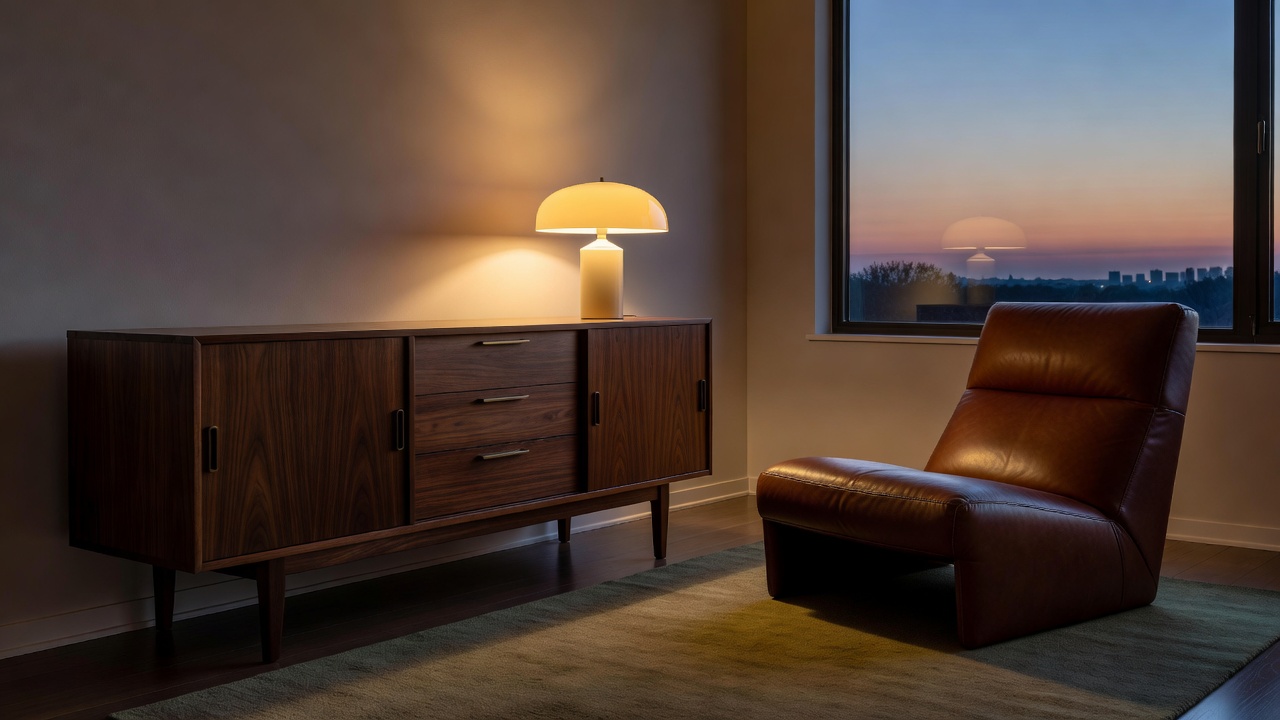
Style labels get thrown around like brand names, but most of them describe a handful of decisions repeated consistently. Japandi is not a shop; it is low furniture, pale timber, paper light and restraint. Moody maximalism is not clutter; it is saturated colour, layered pattern and one controlling idea. Once you see the decisions, you can borrow one or two without signing up for the whole look, which is exactly what a renter with a magnolia wall and a deposit to protect needs.
We judge every style by one test: how does it feel at 10 pm with the big light off? A style that only works in a sunlit photograph will disappoint you for half the year. Below, each style is broken down into the decisions that carry it after dark.
Japandi: calm with a backbone
Japandi blends Scandinavian practicality with Japanese restraint. The furniture sits low, often in oak or ash, and the palette stays in warm whites, clay, stone and charcoal. What makes it work at night is paper light: an Isamu Noguchi Akari lantern, or an affordable rice-paper shade, diffuses a bulb into a soft glow with no hard shadow.
Borrow it: lower your lighting, not just your furniture. Put a lamp on the floor beside the bed. Clear one surface completely. Choose linen bedding in an earthy tone and leave it slightly rumpled. Budget version: a £25 paper shade and a single ceramic bowl do more than a new bed frame.
Avoid: making it cold. Japandi without texture becomes an empty showroom. Add a wool throw, a jute or wool rug and one dark accent, such as a blackened timber stool.
Mid-Century Modern: warm wood, clean lines
Rooted in the 1940s to 1960s, the style is defined by tapered legs, walnut and teak, and icons such as the Eames Lounge Chair and the Poul Henningsen PH5 pendant. The PH5 matters here: its layered shades hide the bulb and throw light downward, which is why mid-century rooms glow rather than glare.
Borrow it: one piece of real wood with visible grain, raised on legs so light passes underneath. Mustard, rust and olive textiles are the classic accents. Second-hand teak sideboards still turn up at reasonable prices in auctions and charity furniture shops.
Avoid: the theme-park version. Not every item needs splayed legs. Mix in one contemporary piece so the room reads as lived-in, not as a period set.
Moody Maximalism: more, but on purpose
Popularised by designers such as Abigail Ahern, this style uses deep walls, layered pattern and abundant objects. It succeeds when there is a clear controlling idea: a dominant colour, a repeated material, or a strict rule like "everything has a warm undertone". Without that rule, it slides into clutter.
Borrow it: pick one deep colour and drench it across walls, skirting and ceiling. Add a pattern at three scales: a large rug, a medium curtain, a small cushion. Light it with five or six low sources rather than one bright one.
Avoid: cool, grey-based darks, which go flat and cave-like under warm bulbs. Look for undertones of red, brown or green.
Wabi-Sabi: beauty in the worn
Rooted in Japanese aesthetics and championed in interiors by Axel Vervoordt, wabi-sabi values imperfection: limewash walls, hand-thrown ceramics, aged timber and undyed linen. It is the most forgiving style for renters because patina is the point.
Borrow it: swap shiny accessories for handmade ones. Let a branch in a heavy vase be the only "decoration" on a table. Use candles and a single low lamp so surfaces show their texture through raking light.
Avoid: confusing it with mess. The calm comes from very few objects, each chosen.
Art Deco: glamour after dark
Born around the 1925 Paris exhibition, Art Deco brings geometry, lacquer, brass, velvet and fan or stepped motifs. It is made for night: reflective surfaces catch lamp light and multiply it.
Borrow it: one curved velvet chair, a globe or fluted glass lamp, a round mirror with a brass frame. Deep emerald, oxblood or aubergine walls make metal glow.
Avoid: too much shine. Balance every metallic with a matte texture, or the room looks like a hotel lobby.
How to choose without a mood board meltdown
Start with what you already own and love. If it is an old oak table, you are halfway to Japandi or mid-century. If it is a pile of patterned textiles from travels, maximalism will welcome them. Fighting your existing furniture is the fastest way to overspend.
Next, look at the room's natural light. A north-facing room in the UK gets cool, even light; it suits warm, deep palettes that cancel the chill. A south-facing room can handle cooler neutrals because the sun warms them. Then decide how the room is used after dark: reading, sleeping, hosting or screen time. A reading room needs a focused lamp; a hosting room needs flattering, low, warm light around the table.
Finally, limit yourself to three decisions: one colour move, one lighting move, one texture move. That restraint is what makes a room feel deliberate rather than decorated. When those three land, add objects slowly over months. Rooms that are finished in a weekend rarely feel personal.
Mixing two styles
The most convincing rooms are hybrids. Japandi and mid-century share warm timber and low lines. Wabi-sabi and moody maximalism share a love of texture. Art Deco pairs well with mid-century because both prize curves and craftsmanship. The rule is to share a palette even when the shapes differ, so the eye finds a thread.
Next, see how colour and light carry these styles in Colour and Light Together, or work out costs in Decor at Every Price.